Cultural Meaning vs. Practical Value: What Influences Tourists’ Decisions to Purchase Traditional Handicrafts?
Traditional handicrafts are an important part of cultural tourism. Visitors often purchase handmade textiles, jewelry, pottery, and other objects as reminders of places they have visited. These products can also introduce tourists to local traditions and support the livelihoods of artisans.
However, cultural significance does not always translate into sales. A handmade scarf may represent generations of weaving traditions, but a visitor might prefer a cheaper refrigerator magnet. Similarly, a tourist may admire a traditional wooden carving without wanting to purchase something difficult to carry home.
This raises an interesting question: What actually influences tourists when they decide whether to buy traditional handicrafts?
This review examines published studies on souvenir purchasing behavior, focusing on cultural authenticity, storytelling, practical usefulness, price, and differences among tourists. It also considers how these findings might apply to Cambodia, where traditional handicrafts are part of the country’s cultural identity and tourism industry.
One important factor is authenticity. Tourists often want souvenirs that genuinely represent the places they have visited rather than products that could have been purchased anywhere.
Littrell, Anderson, and Brown (1993) investigated how 385 American tourists understood authenticity in craft souvenirs. Their findings showed that tourists considered several characteristics, including workmanship, uniqueness, appearance, usefulness, cultural history, and the identity of the craftsperson.
An interesting finding is that authenticity was not defined entirely by traditional production methods. Some tourists also considered whether an item looked attractive or could serve a practical purpose.
A later study by Elomba and Yun (2018), involving 637 tourists in South Korea, found that perceptions of souvenir authenticity differed according to tourists’ nationalities and familiarity with local culture.
These findings suggest that tourists do not necessarily interpret traditional handicrafts in the same way. A Cambodian visitor might recognize the cultural meaning of a particular textile pattern, while a foreign visitor might notice only its colors and design.
For Cambodian handicraft sellers, this creates a communication problem. An object may have considerable cultural significance, but that significance is not automatically understood by the person considering purchasing it.
Another factor is how sellers explain the cultural meaning of their products.
Kumjorn and Chiengkul (2026) examined the relationship between cultural souvenir design, storytelling, and purchase intentions in Thailand. Their research included a survey of 342 domestic tourists who had previously visited Pueai Noi Sanctuary.
The study found that storytelling was a particularly strong predictor of purchase intention. Cultural designs were more persuasive when they helped visitors connect with a story about the place and its heritage.
This suggests that tourists may respond differently to two otherwise similar products depending on how they are presented.
For example, a seller could describe a Cambodian krama simply as a cotton scarf. Alternatively, the seller could explain its traditional uses, weaving methods, and importance in everyday Cambodian life.
The second explanation gives the product additional meaning beyond its physical appearance.
However, storytelling should not mean inventing historical explanations or exaggerating cultural significance to increase sales. Cultural communication is useful only when the information being shared is accurate.
The Thai study also has limitations. Its participants were domestic tourists visiting a specific heritage site. Its findings cannot automatically be applied to international tourists purchasing Cambodian handicrafts.
Nevertheless, it provides evidence that cultural explanations can influence how consumers evaluate souvenirs.
Cultural meaning is important, but tourists also make ordinary consumer decisions.
He and Timothy (2024) studied tourists’ perceptions of cultural and creative souvenirs in China. They found that visitors valued products that represented particular places, but also considered functionality, price, appearance, and quality.
This finding complicates the assumption that tourists purchase handicrafts mainly because of their cultural importance.
A visitor might appreciate the craftsmanship of a large traditional sculpture but decide against buying it because it is expensive, fragile, or difficult to transport. A smaller handmade textile may be more attractive because it can be used regularly.
A 2024 study on souvenir purchasing decisions, based on responses from 380 university participants in the United States, similarly found that functional and social value significantly influenced purchase intentions.
Functional value concerns what a product can actually do. Social value involves how a purchase relates to relationships or social perceptions, including its suitability as a gift.
These findings suggest that traditional handicrafts can appeal to tourists for several reasons simultaneously.
Someone might purchase a handmade scarf because it represents Cambodian culture, matches their clothing, and makes a suitable gift. The purchase does not need to be explained by only one motivation.
Tourists also arrive with different cultural backgrounds, budgets, and travel experiences.
Elomba and Yun’s research suggests that familiarity with local culture influences how visitors perceive souvenir authenticity. Meanwhile, He and Timothy found that tourists consider both cultural representation and ordinary product characteristics.
Together, these studies indicate that there may be no single effective way to present traditional handicrafts to international audiences.
Some tourists may want detailed information about a craft’s history. Others may be more concerned about its price, durability, or appearance.
This does not mean sellers should change the cultural meaning of their products to satisfy different customers. Rather, they can explain different aspects of the same authentic product.
For example, a tourist interested in history might appreciate learning about traditional weaving techniques, while another visitor might want to know how to wash or wear the finished textile.
Both explanations can be accurate and useful.
Cambodia provides an interesting setting for applying these findings.
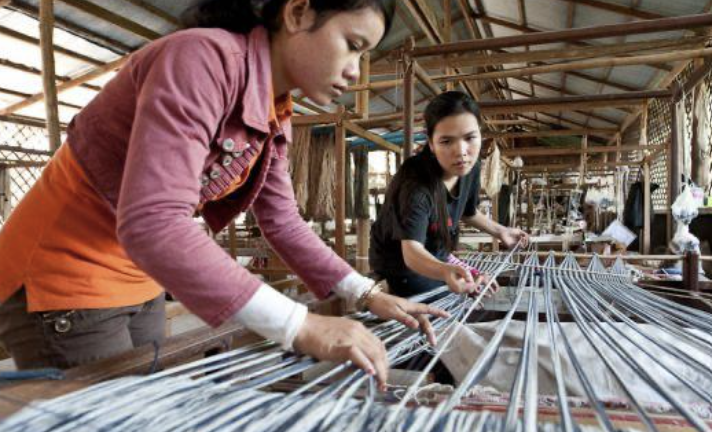
The krama, a traditional woven textile made from cotton or silk, is used in everyday life and during cultural ceremonies. In 2024, UNESCO recognized cultural practices and expressions associated with krama on its Representative List of the Intangible Cultural Heritage of Humanity.
The krama illustrates how cultural meaning and practical usefulness can exist in the same product.
It represents Cambodian identity, but it can also function as a scarf, belt, towel, or other everyday accessory.
Based on the research reviewed, Cambodian handicraft sellers could consider three approaches.
First, they could provide accurate and accessible explanations of products’ cultural origins, materials, and production techniques.
Second, they could communicate practical information about care, durability, size, and everyday uses.
Third, they could consider tourists’ different needs without changing the traditional meaning of the products themselves.
These recommendations are interpretations of research conducted in other tourism settings. Additional research involving international tourists in Cambodia would be necessary to evaluate their effectiveness locally.
The studies reviewed suggest that tourists’ purchasing decisions are influenced by both cultural meaning and practical considerations.
Authenticity and storytelling can help visitors understand why a handicraft is culturally significant. However, price, usefulness, quality, and personal expectations also influence whether someone decides to buy it.
These factors should not be treated as opposites. Traditional handicrafts can preserve cultural heritage while also serving practical purposes.
For Cambodia, the challenge is not simply to persuade tourists that handicrafts are culturally valuable. It is also to communicate that value in ways visitors can understand while providing the practical information they need to make purchasing decisions.
A traditional product does not lose its cultural meaning because someone buys it for everyday use. In some cases, regular use may allow its cultural significance to reach people who would otherwise know very little about it.
SAMBATH CHANSREYLEAP
Elomba, M. N., & Yun, H. J. (2018). Souvenir authenticity: The perspectives of local and foreign tourists. Tourism Planning & Development, 15(2), 103–117. https://doi.org/10.1080/21568316.2017.1303537
He, L., & Timothy, D. J. (2024). Tourists’ perceptions of ‘cultural and creative souvenir’ products and their relationship with place. Journal of Tourism and Cultural Change, 22(2), 143–163. https://doi.org/10.1080/14766825.2023.2293287
Kumjorn, P., & Chiengkul, W. (2026). From motifs to stories: How semiotic design triggers storytelling and drives souvenir purchase intentions in cultural heritage tourism. Journal of Hospitality and Tourism Insights. https://doi.org/10.1108/JHTI-11-2025-1393
Littrell, M. A., Anderson, L. F., & Brown, P. J. (1993). What makes a craft souvenir authentic? Annals of Tourism Research, 20(1), 197–215. https://doi.org/10.1016/0160-7383(93)90118-M
UNESCO. (2024). Cultural practices and expressions linked to Krama, a traditional woven textile in Cambodia. https://ich.unesco.org/en/RL/02115
The influence of value perceptions on tourist souvenir purchase decisions. (2024). International Journal of Tourism Research, 26(1), e2611. https://doi.org/10.1002/jtr.2611